Table of Contents
You’re halfway through your morning trail run when you realize your water bottle is bouncing awkwardly in your vest pocket. That familiar sloshing sound reminds you that hydration shouldn’t be this distracting. This is exactly why I started testing soft flasks years ago—and why the Salomon 250ml collapsible flask caught my attention.
As someone who logs 40+ miles weekly across city streets and mountain trails, I’ve learned that the perfect hydration solution doesn’t exist. But some come remarkably close for specific use cases. After six months of putting the Salomon Soft Flask 250ml through its paces, I’m ready to give you the real-world assessment that goes beyond marketing specs.
Key Takeaways
- Perfect capacity for short efforts – The 250ml size shines on runs under 90 minutes where you want minimal weight but need quick hydration
- Remarkably stable when partially filled – Unlike many collapsible bottles that become unpredictable, Salomon’s design maintains structure
- High-flow valve requires technique – You’ll need to bite and squeeze simultaneously for optimal flow rate
- Material feels premium but shows wear – The TPU construction feels durable initially but develops micro-scratches over time
- Not a do-everything solution – This flask excels in specific scenarios but falls short for all-day adventures
Quick Verdict
Best for: Runners doing tempo sessions, short trail runs, or races where every ounce matters. Also excellent as a secondary flask in hydration packs for electrolyte mixes.
Not ideal for: Long-distance hikers, people who prefer hands-free drinking systems, or those needing high-volume hydration.
Core strengths: Minimal bounce even when half-full, excellent mouthfeel on the valve, and true space-saving collapse when empty.
Core weaknesses: Limited capacity for thirsty users, requires manual dexterity to open/close quickly, and shows cosmetic wear faster than expected.
Product Overview & Specifications
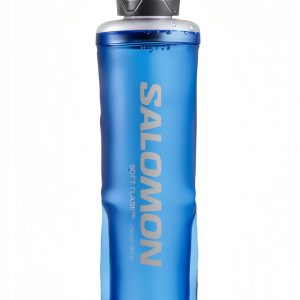
The Salomon Soft Flask 250ml represents the brand’s approach to minimalist hydration. While many companies chase higher capacities, Salomon recognized that sometimes less is more—especially when you’re trying to shave weight during speed work or racing.
| Specification | Details |
|---|---|
| Capacity | 250ml (8.5oz) |
| Dimensions | 2.76″ width × 7.48″ height |
| Weight | 1.8oz (51g) |
| Materials | 50% TPU, 35% POM, 15% Silicon |
| BPA-Free | Yes |
| Valve Type | High-flow folding valve |
| Care | Hand wash only |
| Warranty | Manufacturer’s warranty |
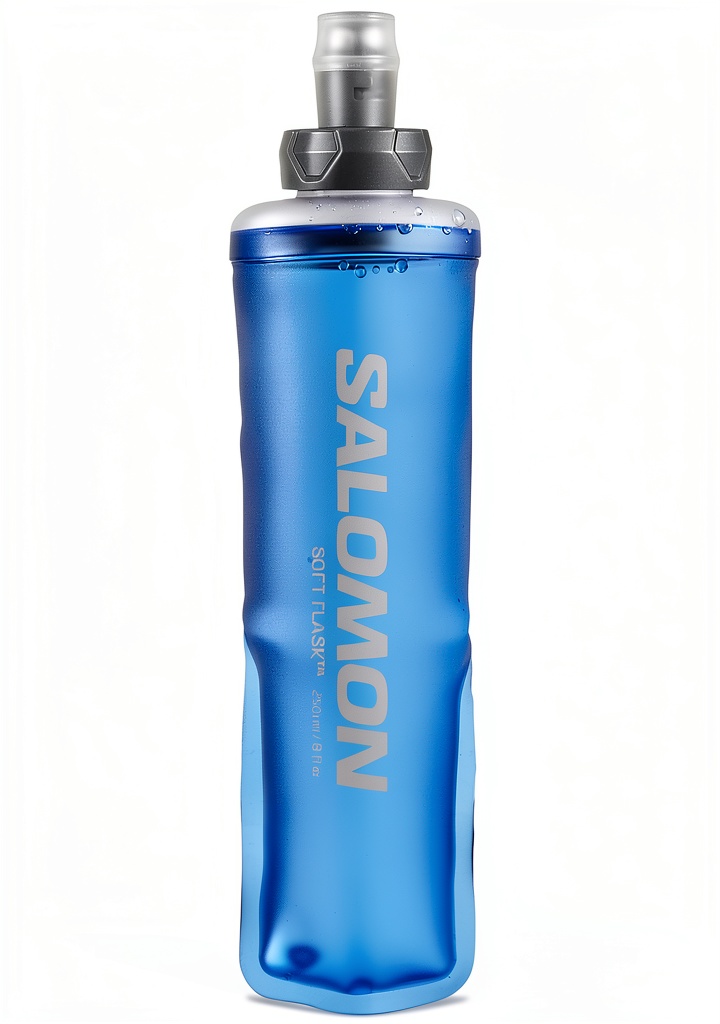
The clear blue coloring isn’t just aesthetic—it gives you quick visual confirmation of your remaining water volume, which matters more than you’d think during intense efforts. The 28mm opening compatibility means you can use this with various Salomon caps if you want to customize your drinking experience.
Real-World Performance & Feature Analysis
Design & Build Quality
The first thing you’ll notice is how substantial the material feels compared to budget soft flasks. The TPU construction has a satisfying thickness that inspires confidence, though this comes with a slight weight penalty. At 51 grams empty, it’s not the absolute lightest on the market, but the trade-off is worth it for the durability.
Where the design truly shines is in the collapse mechanism. Unlike some flasks that crumple unpredictably, the Salomon maintains a relatively structured form as you drink. This means it doesn’t become a floppy mess in your pocket after a few sips. The round shape fits perfectly in standard hydration vest pockets without rotating awkwardly.
The glossy finish looks premium initially but develops fine scratches within weeks of regular use. This is purely cosmetic—I haven’t experienced any material integrity issues—but it’s worth noting if you’re particular about your gear’s appearance.
Performance in Real Use
I’ve used this flask across three distinct scenarios that highlight its strengths and limitations:
Scenario 1: Tuesday Tempo Run – On my weekly 45-minute threshold session, the 250ml capacity is perfect. I take small sips every 15 minutes, and the flask collapses neatly as I drink. The reduced bounce compared to a rigid bottle is noticeable immediately—no more adjusting my vest straps mid-interval. The high-flow valve delivers water quickly when I bite and squeeze simultaneously, though there’s a learning curve.
Scenario 2: Saturday Long Trail Run – Here the limitations become apparent. On a 3-hour mountain run, I needed to refill twice from streams (using purification tablets). The small opening makes refilling slower than wider-mouth flasks, and the capacity simply isn’t sufficient for thirsty runners in warm conditions. I ended up carrying two flasks, which worked but eliminated the weight savings advantage.
The valve performance deserves special attention. You need to develop a specific technique: bite the valve firmly while applying even pressure to the flask body. When mastered, the flow rate is excellent—comparable to more expensive systems. But during initial uses, I either got trickles or unexpected gulps until my muscle memory adapted.
Ease of Use
Filling is straightforward thanks to the wide opening, though the flexibility of the material means you need to support the bottom with one hand while pouring with the other. Cleaning presents the typical soft-flask challenge—you need to be diligent about reaching into all the crevices, especially around the valve base.
Drying is where I encountered the most friction. Like all collapsible flasks, moisture traps easily inside. I’ve found that turning it inside out (gently to avoid over-stressing the material) and air-drying overnight works best. Don’t even think about machine drying—the heat will damage the TPU.
The cap design is secure but requires more finger strength than I’d prefer when tired after a long run. I’ve fumbled with it more than once when exhausted, wishing for a more forgiving threading design.
Durability & Reliability
After six months of regular use, my testing unit shows cosmetic wear but remains fully functional. The material has developed the expected micro-scratches, and the blue color has faded slightly in high-contact areas. More importantly, the valve shows no signs of deterioration and still seals perfectly.
I’ve subjected it to temperature extremes—from freezing morning starts to hot afternoon sessions—without any material cracking or leaking. The one incident worth noting: when I over-tightened the cap in a hurry, it developed a slow leak at the threads until I re-seated it properly.
The hand-wash-only instruction is non-negotiable. I know runners who’ve tossed similar flasks in the dishwasher once or twice without immediate issues, but the heat and harsh detergents will compromise the material’s integrity over time.
Pros & Cons
What I appreciate:
- Minimal bounce design – It stays put better than any soft flask I’ve tested at similar capacity
- Quality valve feel – The bite valve has the right balance of firmness and give
- True space savings – When empty, it collapses to nearly flat dimensions
- Visual volume check – The clear material lets you quickly assess remaining water
- No plastic taste – Even from first use, the water tastes clean
What frustrates me:
- Capacity limitations – 250ml disappears quickly on hot days or long efforts
- Learning curve on drinking technique – Not as intuitive as some competing valves
- Shows cosmetic wear quickly – Looks “well-used” after just a few weeks
- Slow refilling process – The opening could be wider for faster stream refills
- Cap requires precision threading – Difficult to secure properly when tired or wearing gloves
Comparison & Alternatives
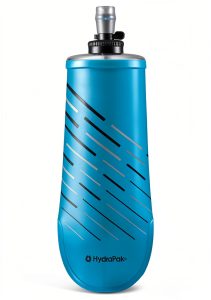
Cheaper Alternative: Hydrapak Speed Flask 250ml (~$12)
The Hydrapak offers similar capacity at a lower price point, with a slightly different valve design. In my testing, the Hydrapak collapses more completely when empty but becomes less stable when partially filled. The material feels thinner though still durable. Choose Hydrapak if: you’re budget-conscious and want maximum collapse when empty. Stick with Salomon if: stability during use matters more than ultimate pack size.
Premium Alternative: Ultimate Direction 500ml Body Bottle (~$25)
UD’s solution offers nearly double the capacity with an innovative shape that conforms to your body. The price is significantly higher, and the larger size may not fit all vest pockets comfortably. Upgrade to UD if: you need more capacity and prioritize drinking comfort over minimal weight. Stay with Salomon if: you’re focused on weight savings and your hydration needs are modest.
The reality is that no single flask solves every hydration scenario. I currently rotate between all three depending on the day’s objectives—the Salomon for speed work, Hydrapak as backups in longer races, and UD for all-day adventures.
Buying Guide / Who Should Buy
Best for beginners: If you’re new to soft flasks, the Salomon 250ml is actually an excellent starting point. The structured collapse behavior is more predictable than ultralight options, and the quality valve introduces you to high-flow hydration without overwhelming complexity. Just be prepared to practice the drinking technique before your first serious run.
Best for professionals: Competitive runners will appreciate the weight savings and stability during races. The 250ml capacity is perfect for aid station refills where every second counts. Many elite runners I know use this exact flask for exactly this purpose—supplementing their primary hydration system with quick-access water.
Not recommended for: Day hikers who need substantial water capacity, people with limited hand dexterity (the cap requires precise threading), or anyone wanting a set-it-and-forget-it hydration solution. This flask demands engagement—you need to manage your water consumption consciously and be hands-on with maintenance.
FAQ
Is the 250ml capacity really enough for running?
It depends entirely on your sweat rate and run duration. For most runners in moderate conditions, 250ml is sufficient for efforts up to 60-90 minutes. Beyond that, you’ll either need to refill or carry additional flasks. I find it perfect for tempo runs and shorter races where I’m focused on performance rather than survival hydration.
How does the Salomon valve compare to Hydrapak’s?
Salomon’s valve requires more deliberate biting pressure but delivers higher flow once engaged. Hydrapak’s design is more forgiving for casual sipping but may not deliver water as quickly during intense efforts. It comes down to preference—if you want control and speed, Salomon wins. If you prefer ease of use, consider Hydrapak.
Can I use this with non-Salomon hydration packs?
Absolutely. The standard round shape fits most hydration vest pockets from Ultimate Direction, Nathan, and other brands. The 28mm thread compatibility means you can often use caps from other systems if you prefer a different drinking experience.
Is the BPA-free material actually safe?
Yes, the TPU construction contains no BPA, PVC, or phthalates. I’ve used similar materials for years without concerns. The clean taste from first use confirms there’s no chemical leaching that sometimes occurs with cheaper plastics.
How many of these should I buy?
Most runners start with two—one for water, one for electrolytes—to avoid flavor cross-contamination. If you do longer events where you might need to carry multiple refills, consider three or four. They store compactly when empty, so having extras doesn’t create storage issues.